


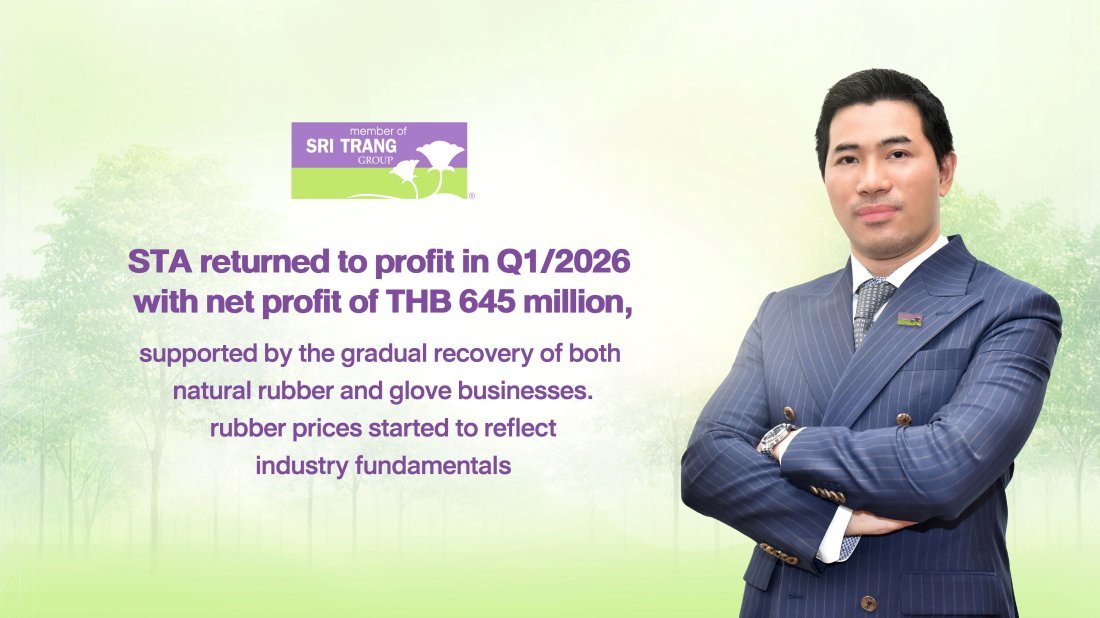
Sri Trang Agro-Industry Public Company Limited (“STA” or the “Company”) reported its operating results for Q1/2026, recording a turnaround to net profit attributable to shareholders of the Company of THB 645.4 million, compared with a net loss of THB 325.7 million in Q4/2025. The recovery was driven by a gradual improvement in both the natural rubber business and the rubber glove business, following the impact of volatility in global natural rubber prices. For Q1/2026, the Company recorded total revenue from sales and services of THB 26,841.8 million, an increase of 0.6% from the previous quarter. EBITDA stood at THB 2,369.3 million, up 307.4% QoQ, representing an EBITDA margin of 8.8%. This reflected the recovery in operating performance across the Company’s two core businesses.
Mr. Veerasith Sinchareonkul, Chief Executive Officer of Sri Trang Agro-Industry Public Company Limited, or STA, the world’s largest fully integrated natural rubber enterprise and Thailand’s leading rubber glove manufacturer, stated that the Company’s natural rubber and rubber glove businesses began to gradually recover in Q1/2026, after having faced pressure in the preceding period from volatility in global natural rubber prices, as well as the impact of the flooding incident toward the end of last year. “Global natural rubber prices have begun to move more in line with industry fundamentals after previously being pressured by external factors and some speculative activity. Meanwhile, overall natural rubber supply from several major producing countries has not increased significantly, particularly in Thailand and Indonesia, where production constraints remain. As a result, the industry has started to return to a more balanced condition. Over the past week, TSR20 rubber prices on the SICOM market have moved within the range of approximately 215-220 cents per kilogram,” Mr. Veerasith said.
The Company’s natural rubber business began to recover in line with the direction of global rubber prices. The average TSR20 rubber price on the SICOM market in the first quarter of 2026 was 191.5 cents per kilogram, an increase of 10.6% from the previous quarter. Natural rubber sales volume stood at 341,786 tons, while the gross profit margin of the natural rubber business improved to 8.7%, compared with 5.7% in the previous quarter. At the same time, the rubber glove business resumed normal operations following the flooding incident toward the end of last year. As a result, sales volume recovered to 9,159 million pieces, an increase of 4.6% from the previous quarter, while the utilization rate rose to 84.2%, compared with 78.2% in the previous quarter. In addition, the Company began to gradually recognize partial insurance claim proceeds related to the flooding incident during the quarter, which further supported its operating performance.
In terms of financial position, the Company remained strong. As of 31 March 2026, the Company’s net debt-to-equity ratio stood at 0.63 times, while its current ratio was 1.93 times, reflecting its ability to efficiently manage liquidity and debt obligations.
Looking ahead, the Company expects natural rubber prices to move more in line with industry fundamentals. However, key risk factors will continue to be closely monitored, including global economic uncertainty, international trade policies, weather volatility, and geopolitical developments that may affect the cost of petrochemical raw materials, particularly naphtha, an upstream raw material for butadiene, which is a key feedstock used in synthetic rubbers such as NBR and SBR.