


Human rights management framework
The Company is committed to respecting, supporting and upholding human dignity and human rights, which are basic rights and freedoms that all individuals should have, and is aware of the potential negative impacts on human rights issues from business operations, encompassing stakeholders in the value chain, members of staff, employees, business partners, communities and customers. The Company has therefore reviewed its human rights and non-discrimination policies, as well as its social and labor policies, to ensure compliance with international human rights principles and standards, adhering to the UN Guiding Principles on Business and Human Rights (UNGP), comprising the principles of Protect, Respect and Remedy, the Universal Declaration of Human Rights (UDHR), Children's Rights and Business Principles (CRBP) and compliance with the UN Global Compact, including a commitment to protect and respect human rights in various areas to demonstrate its intention to conduct business with respect for human rights and non-discrimination, including the absence of violence, physical and mental abuse and sexual harassment, taking into account social diversity. In addition, it monitors potential human rights risks by conducting a comprehensive human rights due diligence (HRDD) in the business process, as well as setting preventive and remedial measures when there is impact from human rights violations, as the guideline and framework for operations to create confidence in conducting business that respects human rights, whereby codes of conduct have been established for the Board of Directors, executives, and employees at all levels, to which they must adhere.
Respect for the rights of children and commitment to supporting their rights
The Company is among the first 30 organizations to declare its intention to support child-friendly business practices under the 10 Children’s Rights and Business Principles (CRBP) developed by UNICEF, the UN Global Compact, and Save the Children, which have been integrated into the Company’s operational strategies as follows:
| 4 Green Strategy | CRBP Principles | Action |
|---|---|---|
| Green Product |
|
|
| Green production process |
|
|
| Sourcing Green Raw Material |
|
|
| Green Company |
|
- STA STEM Education |
Human Rights Due Diligence Process (HRDD)
The company conducts a comprehensive human rights due diligence process to assess the status of operations across the entire value chain. This enables the identification, prevention, mitigation, and management of actual or potential human rights impacts arising from business operations. The process follows the United Nations Guiding Principles on Business and Human Rights (UNGPs) and the Human Rights Due Diligence Guidelines for Listed Companies issued by the Securities and Exchange Commission of Thailand (SEC). These guidelines serve as a framework for conducting comprehensive human rights due diligence, which is scheduled to be carried out every two years.
The process includes the following steps:
1. Defining the Scope of Assessment
The company has clearly defined the scope of its comprehensive human rights due diligence process to cover all relevant stakeholders, including at-risk and vulnerable groups such as children, persons with disabilities, women, minorities, migrants, third-party contract workers, indigenous peoples, local communities, LGBTQ+ individuals, the elderly, and pregnant women. This assessment applies to all operational areas where the company conducts business or has management control, as well as stakeholders within the supply chain.
The company considers key human rights issues, including labor rights, community and minority rights, supply chain rights, security and safety, environmental protection, and the rights of customers and consumers.
2. Identifying Relevant Human Rights Issues
The company reviews various human rights risk issues across the entire value chain, including both direct activities conducted by the company and indirect activities through business partners, contractors, or joint ventures that may lead to human rights violations. Additionally, the company analyzes human rights trends within the same industry at a global level and categorizes similar issues to develop and update the comprehensive Human Rights Risk Assessment checklist.
Relevant departments are assigned to identify and assess potential human rights risks arising from business operations, ensuring a thorough evaluation of human rights impacts.
The scope of the company's human rights risk and impact assessment
| Labor Rights | Local Community and Indigenous Rights | Supply Chain Rights | Security and Safety Rights | Environmental Rights | Customers and consumers Rights |
|---|---|---|---|---|---|
|
|
|
|
|
|
3. Human Rights Risk Assessment
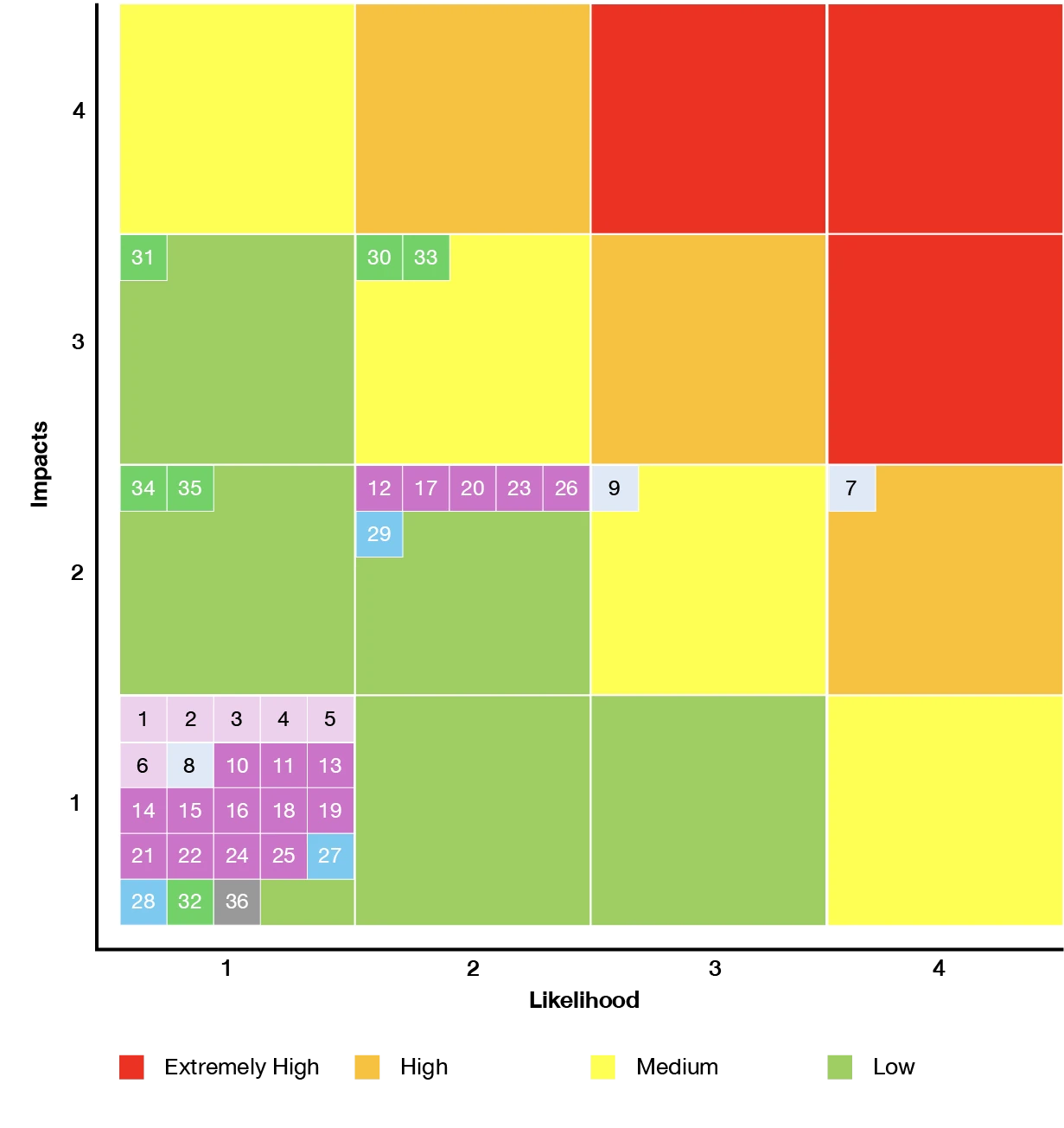
The company incorporates human rights risk issues identified in the comprehensive Human Rights Due Diligence checklist as a tool for risk assessment. A Risk Matrix is used as the assessment tool, considering the risk level of impacts and the likelihood criteria of occurrence for each human rights issue.
| Residual Risk Rating | Existing Control Assessment | Control, Monitoring, and Mitigation Plan |
|---|---|---|
| Extremely High |
|
|
| High |
|
|
| Medium |
|
|
| Low |
|
|
Risk level
The assessment of risk levels and human rights impacts is divided into four levels: low risk, medium risk, high risk, and very high risk.
Likelihood
The likelihood assessment is a criterion used alongside risk level to assist evaluators in decision-making. The likelihood assessment criteria are divided into the following levels: low, medium, high, and very high likelihood.
The relevant departments have been assigned to conduct a comprehensive human rights due diligence risk assessment, covering the business operations of the group of companies, accounting for 100% of the operational areas.
The results of the comprehensive human rights due diligence assessment in the company's business operations identified one risk issue as follows:
Environmental rights risk
A risk was identified in the area of pollution management from operations, which may have environmental impacts on the communities surrounding the factory. The assessment results indicate a medium-level risk.
4. Establishing impact mitigation and prevention measures.
The company has established preventive and mitigation measures based on the human rights risk assessment to serve as guidelines for reducing and controlling negative impacts to a low or acceptable level.
The company has prepared preventive measures and impact mitigation measures as follows:
| Risk issue | Characteristics of potential risk | Preventive and mitigation measures to reduce possible impacts |
|---|---|---|
|
|
|
5. Monitoring and reviewing human rights performance.
The company has established key performance indicators to monitor and review measures for mitigating and controlling negative impacts from human rights risks across all identified issues. These include metrics such as the number of complaints received and resolution status. The results are regularly reported to management for review to ensure that each human rights risk issue is effectively addressed and prevented.
Additionally, as human rights issues may evolve due to changes in business activities and stakeholder expectations, the company conducts regular reviews of its human rights practices. This includes identifying and assessing human rights risks, implementing mitigation and prevention measures, and ensuring that grievance mechanisms are available for employees and stakeholders in cases of human rights violations related to the company's business activities. These efforts aim to facilitate continuous improvement and ensure the effectiveness of the company's human rights management processes.
6. Remediation and corrective actions.
The company recognizes the importance of conducting business with respect for human rights. Therefore, it has established remediation measures and compensation mechanisms for those who may be affected by human rights impacts resulting from its operations. Additionally, the company conducts lesson-learned reviews to develop preventive measures to avoid recurrence. These actions are reviewed and approved through a structured decision-making process by management to ensure accountability, build stakeholder confidence, and uphold the company’s commitments.
Key operating results in 2025
| Target | Outcome |
|---|---|
| Zero (0) number of human rights violations and discrimination. | 0 case(s) |
Communicating human rights knowledge throughout the organization
The Sri Trang Group is committed to integrating ESG principles into its business operations, with a strong emphasis on respecting and protecting human rights across all stakeholder groups, including employees, customers, business partners, farmers, and communities. During the past year, the Company conducted an online training program entitled “Human Rights in Business” to enhance awareness and understanding of human rights practices. In addition, the course “Human Rights and Non-Discrimination” was incorporated into the E Self-Learning system for employees at all levels. Furthermore, STA was invited as a speaker at the seminar “Integrating Human Rights into Business,” organized by the Thai Listed Companies ESG Network, to share best practices and lessons learned in line with the UN Guiding Principles on Business and Human Rights (UNGPs). This reflects the Company’s ongoing commitment to continuously elevating human rights standards within the Thai business sector.
Negotiation
The Company facilitates communication between management representatives and employee representatives through the Welfare Committee, whose members are elected by employees, to jointly negotiate employee benefits in accordance with applicable national labor laws. Regular meetings are held between management and the Welfare Committee, and 100% of employees are covered by collective bargaining agreements. In addition, the Company provides grievance and suggestion channels through written correspondence and email addressed to the Company Secretary to enhance transparency and build trust. The Company has had no significant labor disputes, no human rights complaints, no material violations of social laws or regulations, and no cases of alleged negative social impacts over the past three years.
Complaint Mechanism
The Company has established a complaint policy and guidelines for a grievance mechanism that cover all stakeholder groups, enabling them to report inappropriate conduct or human rights violations safely and transparently. This aligns with the UN Guiding Principles on Business and Human Rights (UNGPs), which emphasize protection, respect, and remedy. Complaints can be submitted through multiple channels, including postal mail, email to the Company Secretary, complaint boxes, QR codes, and direct contact with the responsible department. The mechanism is designed to maintain confidentiality, prevent retaliation, and ensure fair investigation procedures, reinforcing the Sri Trang Group’s commitment to conducting business with genuine respect for human rights.
Channels for receiving complaints and reporting clues
Complainants can report complaints or provide whistleblowing information to the Company’s Board of Directors through the Company Secretary, or to the Audit Committee through the Audit Committee Secretary, using the most appropriate channel depending on the situation, as follows:
1. By postal mail or in person:
Contact: Company Secretary
Address: Sri Trang Agro-Industry Public Company Limited, Park Ventures Ecoplex, Room No. 1701, 1707–1712, 17th Floor, 57 Witthayu Road, Lumphini Subdistrict, Pathumwan District, Bangkok 10330, Thailand
2. By telephone or email:
Contact: Company Secretary
Phone: +66 2207 4590
E-Mail: corporatesecretary@sritranggroup.com
3. Complaint boxes located at the Group’s factories and branch offices, as well as at the Human Resources Employee Relations department. Complainants can also submit reports through appropriate channels, including online (QR Code) and paper forms.
Protection of Personal Data
Sri Trang Agro-Industry Public Company Limited and its subsidiaries recognize the importance of personal data protection in accordance with the Personal Data Protection Act B.E. 2562 and other relevant laws.
The Company has established a committee and a working group in accordance with the Personal Data Protection law to effectively oversee related activities in compliance with legal requirements. A Data Governance Standard Policy and Procedure has been implemented to provide guidelines for managing personal data, overseeing risk, preventing data breaches, and conducting employee training and awareness programs. The Company also continuously reviews and updates its data protection measures to ensure alignment with applicable laws and evolving technologies.
In operational terms, the working group, Data Protection Officer (DPO), and managers or representatives from each department collaborate to prepare a Record of Processing Activities (ROPA), which details the processes of collecting, using, and disclosing personal data. They also conduct Gap Assessments and review and update related documents and contracts to ensure compliance with the Personal Data Protection Act B.E. 2562.
In 2025, the Company implemented the OneTrust program to enhance the efficiency of personal data management. The system covers the preparation and management of Privacy Notices linked to the Company’s websites and systems, Consent Forms and Data Subject Requests (DSARs), Record of Processing Activities (ROPA) along with Data Flow Analysis, and a Personal Data Incident Management system. All activities are conducted under the oversight of the working group and the Data Protection Officer (DPO) to ensure compliance with the Personal Data Protection Act B.E. 2562
The Company has had no significant labor disputes, no human rights complaints, and no material violations of social laws or regulations.