


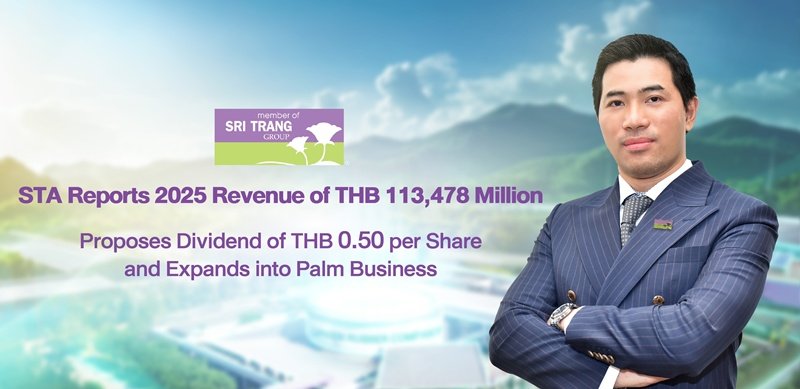
Sri Trang Agro-Industry Public Company Limited (“STA” or the “Company”) announced its financial results for 2025, reporting total revenue from sales and services of THB 113,477.8 million, comparable to the previous year. In the fourth quarter of 2025, natural rubber sales volume rebounded by 39.2% quarter-on-quarter (QoQ), driving a 23.7% QoQ increase in total revenue to THB 26,677.4 million. The Board of Directors has resolved to propose a dividend payment from retained earnings at the rate of THB 0.50 per share, with the ex-dividend (XD) date scheduled for 21 April 2026, subject to shareholders’ approval.
Mr. Veerasith Sinchareonkul, Chief Executive Officer of Sri Trang Agro-Industry Public Company Limited, the world’s largest fully integrated natural rubber enterprise and Thailand’s leading rubber glove manufacturer, stated that the natural rubber industry in 2025 experienced heightened volatility, particularly as a result of U.S. retaliatory tariff measures. These measures led to a decline of more than 20% in global natural rubber prices, with only limited recovery during the second to fourth quarters of 2025 amid ongoing global economic and trade policy uncertainties. Despite external pricing pressures, demand for natural rubber remained relatively stable and broadly aligned with prevailing supply levels.
For the full year 2025, the Company recorded revenue from sales and services of THB 113,477.8 million, consistent with the prior year. The natural rubber business generated revenue of THB 89,617.9 million, with total sales volume of 1,415,715 tons, comparable to the previous year. The glove business reported revenue of THB 23,778.8 million, with total sales volume of 37,102 million pieces, representing a slight decrease of 3.8% year-on-year. In the fourth quarter of 2025, total revenue from sales and services amounted to THB 26,677.4 million, of which revenue from the natural rubber business totaled THB 21,413.8 million, increasing significantly in line with the recovery in sales volume. Revenue from the glove business was THB 5,225.4 million, with sales volume moderating due to flooding in Hat Yai District, Songkhla Province, which affected certain glove manufacturing facilities. The affected facilities are insured, and the Company expects to recognize insurance compensation in 2026.
For 2025, the Company reported a net loss of THB 1,265.7 million, primarily attributable to the recognition of special expenses in the latter part of the year. Nevertheless, fourth-quarter performance improved from the previous quarter, with a net loss of THB 325.7 million, reflecting the normalization of natural rubber sales volumes and a recovery in gross margin.
Mr. Veerasith added that the outlook for the natural rubber industry in 2026 is expected to move toward a more balanced condition as pressures from the futures market experienced in 2025 begin to ease. Global supply remains constrained due to declining plantation areas in major producing countries and weather-related risks that may affect output. The Company believes that rubber prices on the SICOM market have begun to reflect positive momentum since the beginning of 2026. At the same time, the Company continues to closely monitor demand-side factors, particularly global economic trends and the price spread between natural and synthetic rubber. A narrowing price differential would support increased utilization of natural rubber in certain industries and improve price alignment with underlying fundamentals.
In addition, the Company has initiated pilot palm oil business projects across several provinces nationwide to enhance growth potential and diversify business risks. This strategic initiative aligns with sustained strength in palm oil prices and is expected to enhance business stability and create long-term growth opportunities.